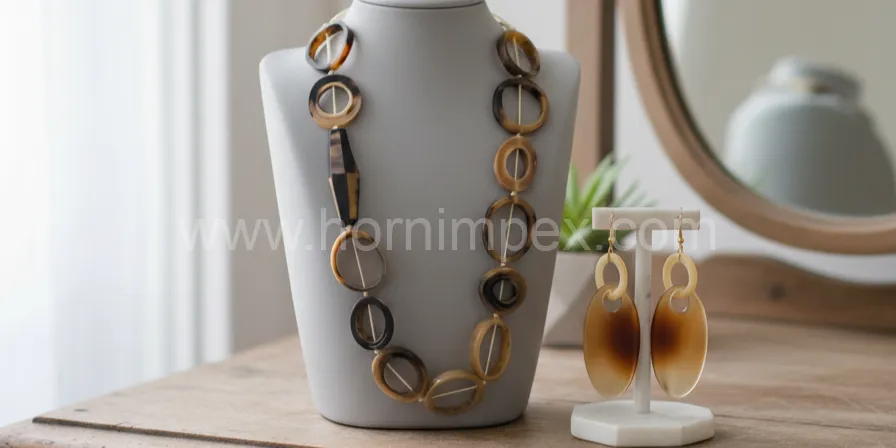
Buffalo horn jewellery often raises questions around sustainability, ethics, and legality—especially as global consumers become more conscious about the materials behind fashion and accessories. Is buffalo horn an animal by-product or a harmful extraction? Does its use support ethical livelihoods or environmental harm? And how do regulations differ across regions like India, the United States, and Europe? This guide exists purely to educate. It explains what buffalo horn jewellery is, how the material is sourced, the ethical debates surrounding its use, and what buyers and designers should understand before engaging with horn-based products. By separating facts from misconceptions, this article aims to build clarity, trust, and informed awareness around sustainability and ethical practices in the horn jewellery industry.
Buffalo horn has been used for centuries across Asia, Africa, and parts of Europe for tools, accessories, and ornamental items. In jewellery, it is valued for its organic patterns, natural sheen, and durability—qualities that make each piece visually distinct. Unlike synthetic materials, buffalo horn carries natural color variations ranging from ivory and amber to deep black, often within a single piece.
What makes buffalo horn jewellery a topic of ethical discussion is not its appearance, but its origin. Consumers increasingly want to know whether horn jewellery involves harm to animals, whether it contributes to wildlife exploitation, and how sustainable it truly is when compared to alternatives like plastic or resin.
Buffalo horn is composed primarily of keratin, the same protein found in human hair, nails, and animal hooves. This is an important distinction: horn is not bone and not ivory. It does not contain calcium phosphate like bone, nor dentin like ivory.
From a material perspective:
It is biodegradable
It can be reshaped using heat rather than chemicals
It does not release microplastics
It ages naturally instead of cracking like synthetic materials
These properties are why buffalo horn is often discussed in sustainability conversations, especially when compared to petroleum-based fashion accessories.
In ethical supply chains, buffalo horn used for jewellery is sourced as a by-product of the meat and dairy industry. The animals are not raised or killed for their horns alone. After slaughter for food consumption, horns that would otherwise be discarded are collected, cleaned, and processed for craft use.
In regions like India, domestic water buffalo are widely raised for agricultural and dairy purposes. Their horns are legally classified as agricultural by-products, not wildlife derivatives. This distinction plays a crucial role in ethical and legal assessments of horn jewellery.
Sambhal, a historic craft town in Uttar Pradesh, is globally recognized for horn and bone craftsmanship. Artisans here often inherit their skills across generations, using hand tools and low-energy processes rather than industrial manufacturing.
Key characteristics of Sambhal horn craftsmanship:
Minimal mechanization
Hand polishing using natural abrasives
Small-batch production
Skill-based livelihoods supporting artisan families
From an ethical lens, such craftsmanship supports local economies, skill preservation, and low environmental impact, especially when compared to mass-produced accessories.
Sustainability in buffalo horn jewellery depends on how the material is sourced and how it is processed.
Ethically managed horn jewellery:
Uses waste by-products
Avoids endangered species
Operates within local and international laws
Employs artisans under safe conditions
Concerns arise only when supply chains lack transparency or when horn is confused with restricted wildlife materials. Understanding these nuances is essential for ethical evaluation.
Looking to know more? Get in touch
India:
Buffalo horn from domesticated animals is legal to process and export when sourced with proper documentation. It does not fall under wildlife protection laws.
United States:
Buffalo horn jewellery is legal to import if it is clearly declared, non-endangered, and not confused with ivory or protected species materials. Proper labeling is critical.
European Union:
EU regulations allow buffalo horn products as long as they meet customs, hygiene, and material disclosure requirements. It is not restricted like ivory or exotic animal parts.
Legality issues usually stem from mislabeling, not from the material itself.
The main ethical questions include:
Was the animal harmed specifically for the horn?
Is the species domesticated or wild?
Are artisans paid fairly?
Is the supply chain transparent?
When buffalo horn is sourced as a secondary material from regulated agriculture, ethical concerns are significantly reduced compared to materials like ivory, tortoiseshell, or exotic leathers.
Beyond jewellery, buffalo horn is used in:
Buttons and accessories
Eyewear frames
Decorative handicrafts
Musical instrument components
These industries value horn for its durability and natural origin, especially as alternatives to plastic gain attention.
A common misconception is that all animal-derived jewellery is restricted. In reality:
Horn ≠ ivory
Domestic buffalo ≠ wildlife species
Ethical by-products ≠ animal exploitation
Clear documentation, HS codes, and material declarations prevent most trade issues.
Assuming horn is illegal without verification
Confusing buffalo horn with bone or ivory
Ignoring origin documentation
Overlooking artisan working conditions
Focusing only on material, not process
Informed awareness helps buyers and designers make responsible choices.
Contact UsYes, buffalo horn jewellery is legal in the United States when it is sourced from domesticated animals and properly declared during import. It is not classified as ivory or a protected wildlife product. Accurate labeling and documentation are essential to avoid customs issues.
Buffalo horn jewellery can be ethical when the horn is obtained as a by-product of the food or dairy industry. Ethical concerns mainly arise when sourcing lacks transparency or involves wildlife species, which is not the case with domesticated buffalo.
Buffalo horn is biodegradable, long-lasting, and naturally sourced, whereas plastic is petroleum-based and contributes to long-term pollution. When ethically sourced, horn jewellery has a lower environmental footprint than synthetic alternatives.
Ethical buffalo horn jewellery does not involve killing animals for their horns. The horn is collected after animals are processed for food, making it a secondary use rather than a primary cause of harm.
No. Buffalo horn is made of keratin, while ivory consists of dentin. They are chemically, legally, and ethically different materials. Horn is not subject to the same international bans as ivory.
Sambhal has a long history of horn and bone craftsmanship, supported by skilled artisans using traditional methods. The region is known for hand-finished work and ethical small-scale production rather than mass manufacturing.
Yes, designers focused on sustainable fashion often use buffalo horn due to its natural origin, durability, and biodegradability—provided the sourcing is ethical and transparent.
The Ethical Difference: Why HornImpex is...
No reviews available for this blog.