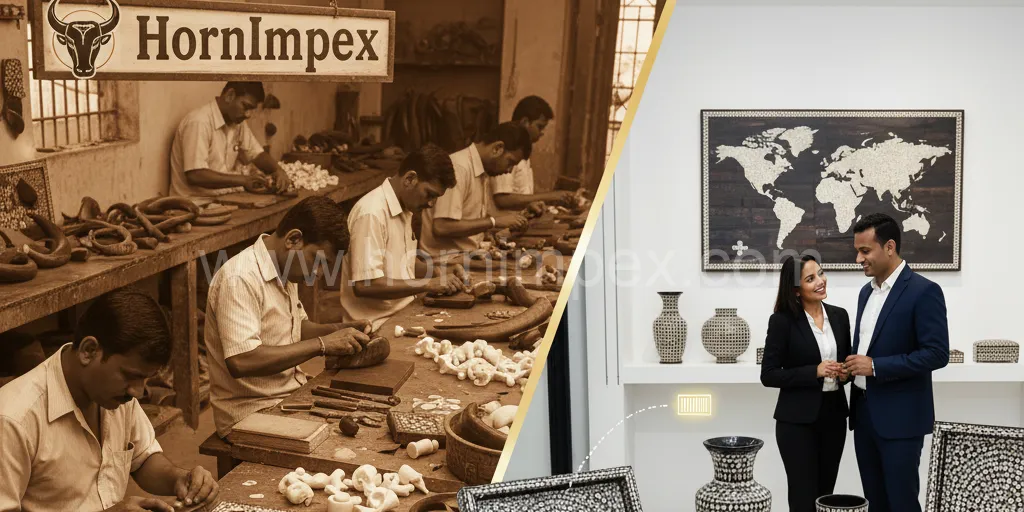
Buffalo horn is primarily composed of keratin, the same protein found in human hair and nails. It is dense, slightly flexible, and resistant to minor impacts.
Bone, by contrast, is rich in calcium phosphate, making it harder but more brittle than horn.
| Property | Buffalo Horn | Bone |
|---|---|---|
| Composition | Keratin protein | Calcium mineral matrix |
| Flexibility | Slightly flexible | Rigid |
| Grain Pattern | Translucent, layered | Opaque, porous |
| Impact Resistance | Moderate | High but brittle |
For door knobs, horn offers a smoother polish and layered natural patterns, while bone provides sharper carving detail.
In regulated handicraft industries, buffalo horn and bone are by-products of the meat industry. They are not sourced from protected wildlife species.
India, particularly the city of Sambhal, is historically known for horn and bone craftsmanship. Artisans work with material that would otherwise enter waste streams, contributing to material circularity.
Ethical sourcing requires:
Verification that material comes from domesticated livestock
No involvement of endangered species
Compliance with veterinary and export documentation standards
Crafting involves multiple stages:
Cleaning and curing raw horn and bone
Cutting into blocks
Heat shaping (for horn)
Hand carving or lathe turning
Progressive sanding
Natural polishing with oils or wax
Unlike synthetic hardware, each piece carries natural grain variation. This irregularity is not a defect — it is an inherent feature of organic material.
Furniture makers often prefer horn for its warmth and bone for fine engraving potential.
A key question: Is this material sustainable?
Because buffalo horn and bone are by-products of agriculture, many sustainability analysts consider them a form of waste utilization craft. Instead of landfill disposal, the material gains extended lifecycle through design application.
However, ethical evaluation depends on:
Transparent supply chains
Species verification
Compliance with wildlife protection frameworks
The primary international agreement relevant to wildlife materials is Convention on International Trade in Endangered Species of Wild Fauna and Flora (CITES).
Domesticated water buffalo are generally not CITES-listed, but documentation remains essential.
In most countries, buffalo horn products derived from domesticated animals are legal when:
Species is not endangered
Proper veterinary certificates are provided
Export declarations specify material origin
The United States enforces wildlife trade rules through agencies such as U.S. Fish and Wildlife Service.
The European Union applies regulations under European Commission wildlife trade frameworks.
Importers must differentiate between buffalo horn and restricted materials like rhino horn or ivory.
Misconception 1: All horn materials are illegal.
False — legality depends on species classification.
Misconception 2: Horn equals ivory.
Buffalo horn is keratin-based. Ivory is dentin from elephant tusks.
Misconception 3: Bone hardware is fragile.
Properly cured and sealed bone performs reliably in low-moisture indoor applications.
For commercial investigation purposes, professionals should verify:
Scientific species name on invoice
Veterinary health certificate
Non-CITES declaration (if applicable)
Fumigation compliance where required
Failure to classify materials correctly is a common importer mistake.
Before integrating horn and bone door knobs into projects:
Inspect grain consistency
Check moisture sealing
Test screw anchoring strength
Evaluate polish uniformity
Confirm no surface cracking
Horn tends to adapt slightly to temperature changes, whereas bone may require stable humidity.
| Feature | Horn & Bone | Resin |
|---|---|---|
| Source | Natural by-product | Petrochemical |
| Pattern | Unique natural grain | Uniform |
| Repairability | Limited refinishing possible | Often non-repairable |
| Environmental Impact | Waste reuse | Plastic production impact |
Furniture makers conducting material comparison often prioritize longevity and environmental footprint over uniformity.
Looking to know more? Get in touch
Buffalo horn and bone door knobs occupy a unique position in global craftsmanship. For furniture makers and importers, questions often arise around durability, ethical sourcing, and international legality. Are these materials sustainable? Do regulations restrict their trade? How do they compare to synthetic alternatives? This guide explains the material science behind horn and bone, how artisans craft them, and what furniture professionals should understand before including them in architectural or decorative projects. The goal is clarity — not promotion — so that craft-based decisions can be made responsibly.
Yes, when derived from domesticated livestock and properly documented, buffalo horn and bone products are generally legal. The material must not come from endangered species. Importers should provide species identification, veterinary certification, and confirm that the product does not fall under restricted wildlife categories. Regulatory compliance is essential to avoid customs delays.
Buffalo horn is widely considered a by-product of the meat industry. Instead of being discarded, it is repurposed into handicrafts. Sustainability depends on traceable sourcing and compliance with environmental regulations. When responsibly sourced, it represents material reuse rather than wildlife exploitation.
Horn is composed of keratin and has a smoother, slightly translucent layered appearance. Bone is mineral-rich, opaque, and better suited for fine carving. Horn offers moderate flexibility, while bone is more rigid. Both materials require proper curing to prevent cracking.
Properly processed horn is stable in indoor environments. However, extreme humidity shifts may cause minor warping. Professional curing, sealing, and finishing significantly reduce this risk. Quality control during manufacturing plays a critical role in durability.
Bone used in handicrafts is typically an agricultural by-product. When traceable and legally sourced, it represents waste utilization. Environmental friendliness depends on responsible sourcing, minimal chemical processing, and compliance with trade standards.
Importers should request species declarations, sourcing transparency statements, veterinary certificates, and confirmation of compliance with wildlife regulations. Auditing supply chains and reviewing export documentation reduces compliance risk.
They are suitable for decorative and moderate-use applications. For heavy commercial traffic, reinforcement design and internal metal fittings are recommended. Material strength varies depending on thickness and craftsmanship.
How Indian Artisans Create Authentic Mos...
No reviews available for this blog.